
Fast vs. Slow Sea Freight for FBA: How Should Sellers Choose?
For cross-border e-commerce, sea freight remains one of the most reliable ways to move goods into Amazon FBA warehouses. But sellers often face a key question: should you ship by fast vessel or slow vessel? The choice directly impacts your shipping costs, inventory turnover, and customer satisfaction
1. Routes and Port Calls
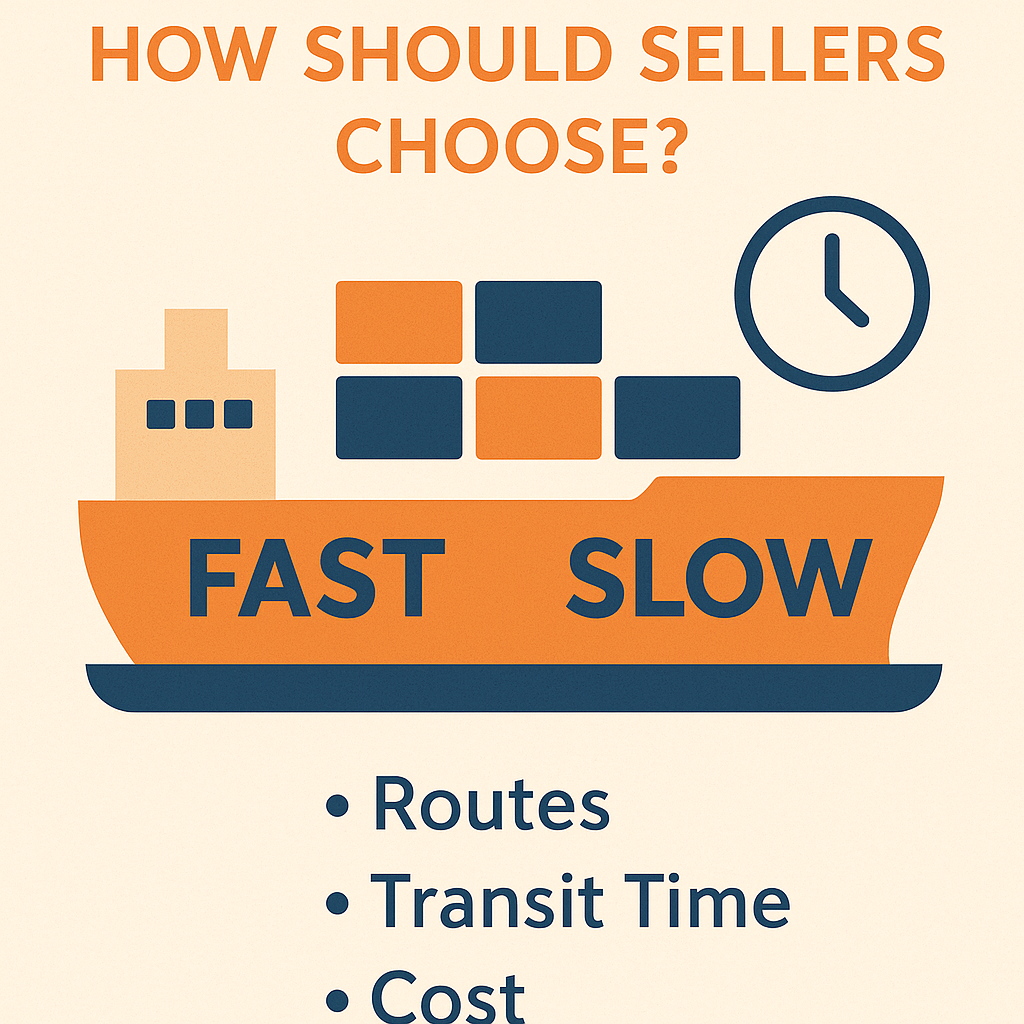
Fast Vessels: Designed for efficiency, these ships usually sail directly from China’s major ports to U.S., Canadian, or European destinations with minimal stops. This reduces delays and ensures more predictable transit times.
Slow Vessels: To maximize capacity, these ships make multiple transshipments and stop at several ports, which extends overall transit time.
2. Transit Time
Fast Vessels:
Matson CLX: From Ningbo or Shanghai to the U.S. West Coast in about 11 days, with cargo available for pickup within 1–2 days. Full door-to-warehouse delivery usually takes 15–18 days.
ZIM Fast Service: From Yantian to the West Coast in roughly 13 days, with full delivery in 16–20 days.
OA Alliance Service: Typically 18–22 days end-to-end.
Slow Vessels:
Scheduled services usually take 18–25 days before UPS handover.
Non-scheduled services can extend to 40–45 days or longer.
3. Unloading Speed
Fast vessels often have priority at dedicated terminals. For example, Matson’s CLX service unloads at its exclusive Pier C terminal in Los Angeles, where full-container deconsolidation is completed within 48 hours—even during congestion. Slow vessels, by contrast, unload at standard terminals, where clearance can take 3–7 days.
4. Cost Considerations
Fast Vessels: Freight rates are typically 30%–50% higher than slow vessels, reflecting their premium speed and reliability.
Slow Vessels: More budget-friendly, making them suitable for bulk shipments where timing is less critical.
5. Cargo Suitability
Fast Vessels: Ideal for high-value, fast-moving inventory where quick replenishment is essential for maintaining sales and customer satisfaction.
Slow Vessels: Better suited for large, heavy, or lower-value products where cost control outweighs delivery speed.
Key Takeaway
The time difference between fast and slow sea freight can range from 10 to 30 days. Sellers should balance cost, urgency, and product type when choosing between the two.
About Niuku Shipping
At Niuku Shipping, we specialize in end-to-end FBA freight forwarding solutions from China to the U.S., Canada, and Europe. Our services include:
Fast Vessel Services: Matson CLX, ZIM Fast, OA Alliance, and more
Standard & Economy Sea Freight: 25–45 day options across major U.S. ports (LA, Oakland, Seattle, New York)
FBA Last-Mile Delivery: Customs clearance, trucking, and UPS handover
Overseas Warehousing & Fulfillment: Storage, consolidation, and one-piece delivery
Whether you prioritize speed to market or cost optimization, Niuku Shipping delivers tailored logistics strategies to keep your business moving.